History of Golf Games — From Mini Golf Courses to Physics Puzzles
From 1910s mini golf to early Atari and Nintendo golf, Everybody's Golf and Wii Sports, and physics puzzle golf like Desert Golfing and What the Golf?
Golf is a sport that fits video games unusually well. The goal is clear: hit a single ball in a set direction with a set force and sink it in a hole. And since it proceeds one shot at a time, a few buttons are enough to represent it. That's why golf has been made into games steadily from the days when game consoles first appeared up to now.
What's interesting is that golf games have developed along two branches: one that faithfully recreates real golf, and one that enjoys obstacles and gimmicks like mini golf. In this post, we start with the history of mini golf before video games and go in order through early golf games, popular golf game series, and recent physics puzzle golf games.
A Game Before Games: Mini Golf
Mini golf is a pastime that takes only the "putting" out of golf. Short holes, usually under 10 meters, are built on artificial turf, carpet, or concrete, with obstacles such as tunnels, ramps, and windmills that make players think even about shots that bounce off walls. It goes by many names depending on the country, including crazy golf, adventure golf, and putt-putt.
| Year | Event |
|---|---|
| 1912 | The British newspaper The Illustrated London News featured a mini golf course called "Gofstacle" (the earliest recorded mention) |
| 1916 | The "This'll Do" course was built in Pinehurst, North Carolina, USA |
| 1922 | Thomas Fairbairn developed an artificial green mixing cottonseed hulls, sand, oil, and dye |
| 1927 | Garnet Carter patented the "Tom Thumb" course |
| Late 1920s | More than 150 rooftop courses in New York alone, and tens of thousands across the US |
| 1930s | Most US courses closed due to the Great Depression |
| 1937 | The Swedish Minigolf Federation was founded, the oldest existing mini golf sports body |
The mini golf boom that started in the US crossed to Europe, where standardized courses spread in Germany, Sweden, and elsewhere, and Sweden has held an annual national championship since 1939. The core of mini golf is the fun of calculating "at what angle should it bounce off the wall to go into the hole?" This fun later carried straight over into golf puzzles in video games.
Early Video Golf Games (1970s–1980s)
As soon as home game consoles appeared, golf became a game.
- 1979: A golf game came out for Magnavox's Videopac (Odyssey²).
- 1980: Golf for the Atari 2600 came out. Developer Mike Lorenzen recalled struggling to fit the game onto a 2-kilobyte ROM cartridge. It was a simple game of nine holes for one or two players.
- 1984: Golf, made by Nintendo and HAL Laboratory for the Family Computer, came out in Japan, and it launched in North America for the NES in 1985.
Nintendo's Golf is an especially important title. It became the best-selling sports game on the NES/Family Computer and was later re-released on several Nintendo consoles. It's also the first sports game in which Mario appeared as a player. The game's programmer was the late Satoru Iwata, who later became Nintendo's president, and the Nintendo Switch system software contained this game as a hidden element (Easter egg) in tribute to him.
In arcades, Incredible Technologies' Golden Tee Golf (1989) appeared. Its distinctive feature was determining the power and curve of a shot by the speed and direction you rolled a trackball, and it became a long-running arcade series placed mostly in bars. In 1995, a tournament feature comparing scores between machines was also tested.
Mini Golf Becomes a Game: Kirby's Dream Course
Some games opened a different path from regulation golf. Kirby's Dream Course, made by HAL Laboratory and Nintendo for the Super Famicom in 1994, is a mini golf game in which you hit the round Kirby like a ball and get him into the hole.
It was originally being made as a standalone game called "Special Tee Shot," then had its characters changed to match Kirby's popularity. The way you hit enemies to gain abilities and use those abilities to break obstacles or fly can be seen as an early example of the trend of "layering puzzles and action on top of golf rules."
Golf for Everyone: Everybody's Golf and Wii Sports
From the late 1990s, golf games reached a wider audience.
Everybody's Golf (1997–)
Sony's Everybody's Golf (Hot Shots Golf in North America) began with the first title made by Camelot Software Planning in 1997. Clap Hanz then carried on the series. It's known for combining cute cartoon-style characters with precise ball physics, and mini golf courses were included from the very first title. As of March 2017, cumulative series sales exceeded 14 million copies.
On the Nintendo side, the Mario Golf series, handled by Camelot, carried on the same trend.
Wii Sports (2006)
Wii Sports, released with the Wii in 2006, included golf along with tennis, baseball, bowling, and boxing. Swinging the remote like a real golf club was something even people who had never played games could understand immediately, and it expanded golf game controls from buttons to body movement.
Golf as a Physics Puzzle: Mobile and Indie Games
As smartphones spread, golf games changed shape once again, because the pull-and-release finger control matched the motion of "hitting a ball" well.
| Year | Game | Developer | Features |
|---|---|---|---|
| 2011 | Super Stickman Golf | Noodlecake Games | A 2D game mixing platformer and golf |
| 2014 | Desert Golfing | Blinkbat Games (Justin Smith) | Minimalist golf on endlessly continuing sand dunes |
| 2016 | Golf With Your Friends | Blacklight Interactive | Mini golf for up to 12 players together, full release in 2020 |
| 2017 | Golf Story | Sidebar Games | An RPG adventure themed on golf |
| 2019 | What the Golf? | Triband | A comedic physics game that twists golf rules |
In Desert Golfing, you set direction and power with one finger to hit the ball, and each time you sink it, a new course continues. All the ground is sand, so the ball moves unpredictably, and thanks to its endless structure, your score is determined by how long you've played.
What the Golf? was made by Denmark's Triband and released as an Apple Arcade launch title in 2019. The developers said they saw golf as "a sport mostly played by the rich, and therefore a safe target for satire." Each level contains jokes that twist golf rules, such as hitting a house or a car instead of a ball, and the levels were kept short to pack in as many ideas as possible.
What these games have in common is that they focus on "the fun of predicting how the ball will bounce and roll" rather than recreating real golf. This shares the same roots as the fun of calculating bounce angles off walls on mini golf courses 100 years ago.
How to Choose a Golf Game
Golf games can broadly be divided into simulations that recreate real golf, casual games that add characters and exaggerated presentation, and puzzle games that borrow only golf's rules to solve ball trajectories. Even within golf, which game to pick depends on the experience you want.
| Experience you want | Recommended direction |
|---|---|
| The feel of real golf | Simulations that recreate courses, clubs, and wind |
| Light play with family and friends | Character-based games like Everybody's Golf, Mario Golf, and Wii Sports golf |
| Noisy fun with a group | Party mini golf like Golf With Your Friends |
| Short bursts of brainwork | Physics puzzles like Desert Golfing and What the Golf? |
Closing: A Puzzle in a Single Shot
Over half a century, golf games have changed their screens and controls, but the core has always been the same: deciding where and how hard to hit the ball, and the tension of the moment you watch the result. In particular, the mini golf-style fun of calculating bounce angles off walls and obstacles continues in a new form in physics puzzle games.
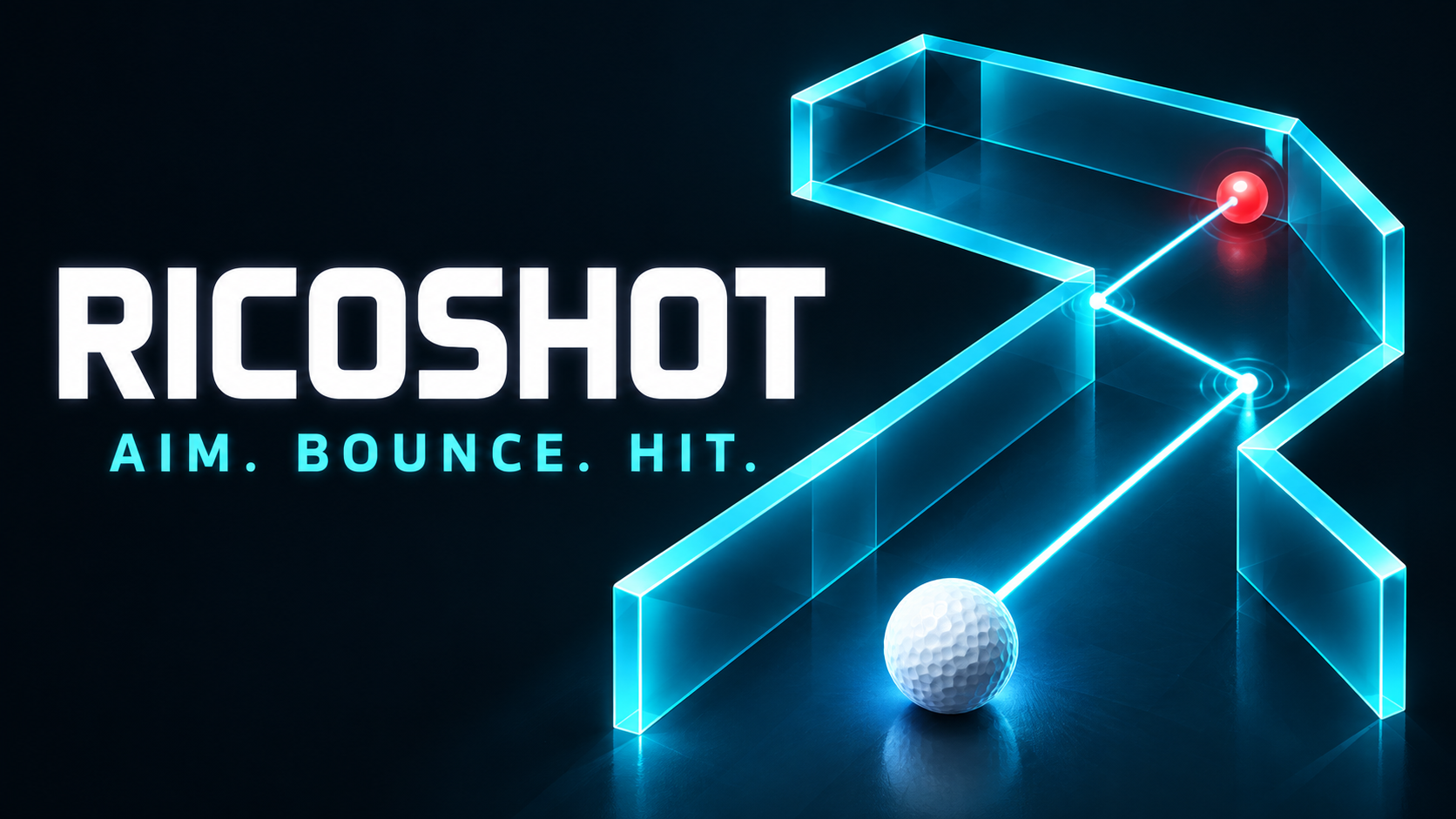
Keke Studio's RICOSHOT: Golf Puzzle is also part of this lineage: a game in which you find the path to bounce the ball off walls and into the hole in a sci-fi themed 3D space.