Why Players Keep Playing: Reward and Motivation in Game Design
Bartle's player types, self-determination theory, Skinner boxes, variable rewards, and Monster Hunter's loop: how games hold players, and the responsibility.
Almost everyone has said "just one more round" and then kept playing until dawn. What pulls us into the next round? It might be the sound effect when you level up, the hope that this time you'll get good gear, or the fun of playing with friends.
In this post, we introduce three frameworks game designers often use to understand player motivation: Bartle's taxonomy, which sorts players into types; self-determination theory, which explains the conditions that make people want to do something on their own; and behavioral psychology, which deals with the timing of rewards. Finally, we talk about the lines developers who use these principles should not cross.
Same Game, Different Reasons: Bartle's Player Types
In 1996, game researcher Richard Bartle proposed four player types based on what players of online games (MUDs) enjoyed in the game. It was originally a classification for multiplayer game players, but today it's widely used when talking about single-player games too.
| Type | What they enjoy | In-game examples |
|---|---|---|
| Achiever | Visible accomplishments like points, levels, and gear | 100% completion, achievements |
| Explorer | Every corner of the world and its hidden rules | Secret places, hidden elements |
| Socializer | Interacting with other players | Guilds, chat, co-op |
| Killer | Competing with and having influence over other players | PvP, rankings |
Bartle explained these four types along two axes. One axis is whether a player is oriented toward other players or toward the game world; the other is whether they want to interact or to act on something one-sidedly.
The biggest lesson this taxonomy offers designers is that "not every player plays for the same reason." For example, achievers will put in a lot of effort even for purely cosmetic rewards. Systems that accumulate points for completing difficult achievements, like the Gamerscore Microsoft introduced on Xbox Live, are built for these players. For explorers, on the other hand, achievement points don't mean much; a single room hidden behind terrain nobody knows about is a bigger reward.
Of course, real people don't fit neatly into one type. Online tests based on Bartle's taxonomy also showed results as a combined mix of percentages across several types. In other words, a single person has multiple motivations mixed together.
Three Things That Make You Want to Do It Yourself: Self-Determination Theory
Self-determination theory, laid out in a 1985 book by psychologists Edward Deci and Richard Ryan, focuses on intrinsic motivation, the kind that makes people do something because they "want to." The two proposed three basic needs that support this motivation.
- Autonomy: the feeling that I am the one choosing
- Competence: the feeling that I'm doing well and getting better
- Relatedness: the feeling of being connected to other people
The theory originally addresses fields like education, work, and health, but it fits games surprisingly well.
Autonomy comes from open worlds, multiple solutions, and stages you can choose in any order. Structures like the Mega Man series, which let the player choose the order of the bosses, are a good example.
Competence comes from clear feedback. It develops when a game clearly tells you what you did well and what improved since last time. Conversely, if outcomes are decided only by luck regardless of skill, competence doesn't build up.
Relatedness comes from co-op, competition, guilds, and, in single-player games, from characters you grow attached to.
From the perspective of self-determination theory, good games put as much effort into "creating" the conditions that make players want to play on their own as into "giving" rewards.
The Timing of Rewards: Skinner Boxes and Variable Rewards
Whenever people talk about reward structures in games, the experiments of behavioral psychologist B. F. Skinner come up. Skinner studied how animals learn behavior through rewards using a box that dispensed food when a lever was pressed (an operant conditioning chamber, commonly called a "Skinner box").
One of the important findings of this research is that the way rewards are given has a big impact on behavior.
- Continuous reinforcement: A reward is given every time the behavior occurs. Learning is fast, but when the rewards stop, the behavior also stops quickly.
- Fixed ratio reinforcement: A reward is given after a set number of times. It's like "defeat 10 enemies to get a reward."
- Variable ratio reinforcement: On average it's once every so many times, but you never know exactly when it will come. It produces the highest response rate, and the behavior persists the longest even after rewards stop. A gambler at a slot machine is the classic example.
Games have used this principle for a long time. "Drop" systems, where you never know what will fall each time you defeat a monster, are exactly variable ratio rewards.
The Core Loop and Monster Hunter
In game design, the loop of actions a player repeats is called the "core loop." It's a cycle: you act, receive a reward, new possibilities open up, and you act again.
Capcom's Monster Hunter series is often cited as a representative example of this structure.
- Hunt or capture a monster.
- Obtain materials from the monster.
- Use the materials to craft stronger weapons and armor.
- Take on harder monsters with your upgraded gear.
On top of this, materials drop randomly (variable ratio), so players repeat the same quest many times to get the materials they want. This loop is powerful because the reward becomes a tool for the next challenge. The reward doesn't end in itself; it leads to the next goal.
Showing players a powerful state briefly at the start of a game and then taking that power away to be rebuilt, or showing a powerful character to plant the goal "you can become like that too," are also common ways to kick off the loop.
The Shadow Side of Reward Design
The same principles can also harm players. Loops that encourage repetitive behavior are sometimes used to fill gaps in content, stretching out play time with tedious repetition and random rewards instead of fun challenges. In particular, randomized items that can be bought with real money (loot boxes) directly link variable ratio rewards to payment, and regulatory discussions about them continue in many countries.
From the perspective of self-determination theory, the problem becomes even clearer. Games that rely only on external rewards lose players the moment the rewards stop. Conversely, games where the challenge itself is fun and the sense of getting better is clear bring people back even without big rewards. Attaching rewards to repetitive tasks and letting players overcome challenges with clear signals of progress may look similar on the surface, but they leave players with different things.
Principles a Small Studio Tries to Keep
Here are the principles we try to follow when designing rewards and motivation.
- Feel comes before rewards. We first check whether a single round is fun even with all the rewards stripped out.
- We signal that skill is improving. We don't hide information that shows competence, like records, star ratings, and shorter clear times.
- We don't tie payment to random rewards. We believe luck is a seasoning that adds fun, not a device for opening wallets.
- We let players quit feeling good. Rather than mechanisms that force players to log in, we leave them a reason to want to come back next time.
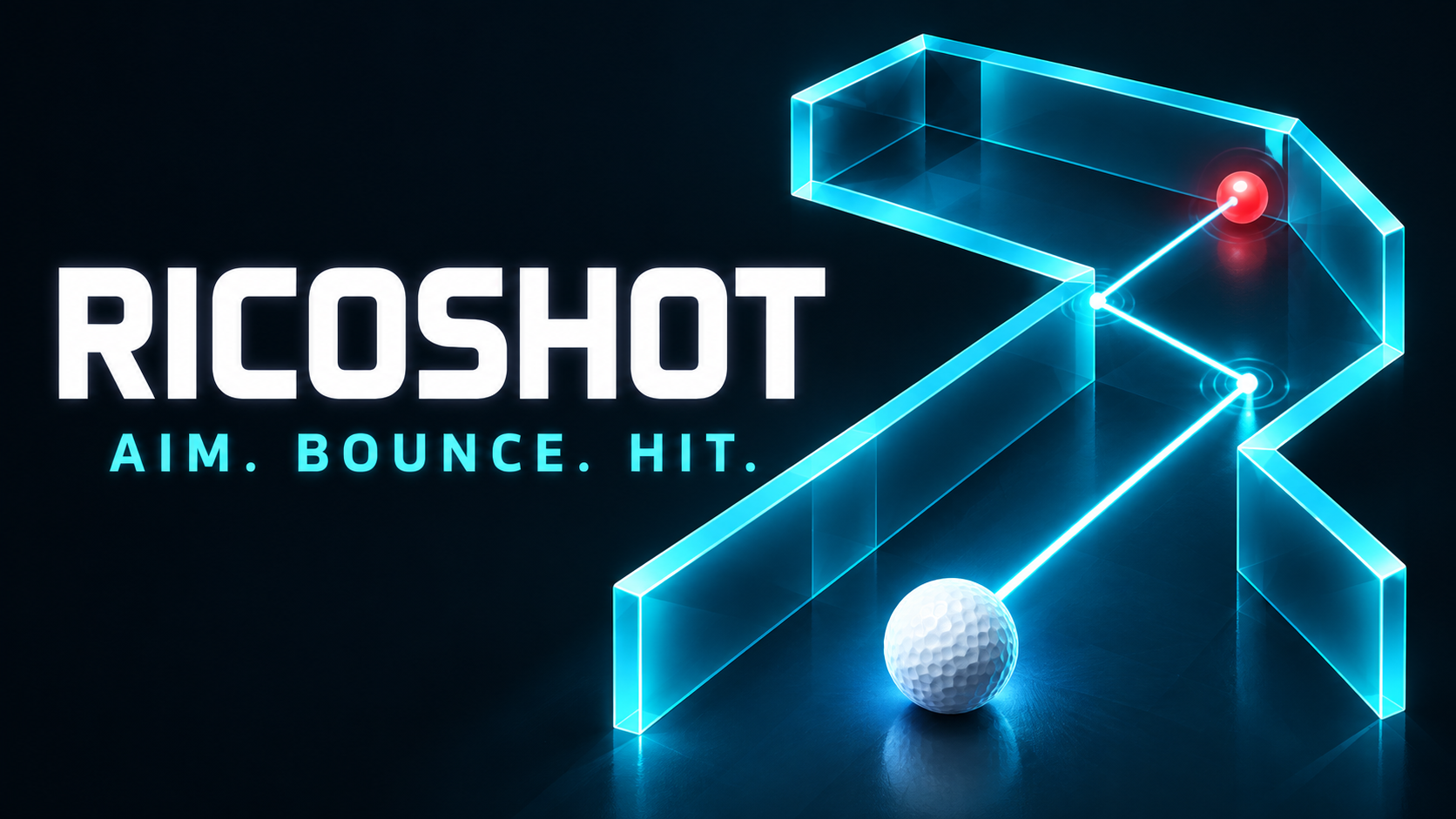
RICOSHOT: Golf Puzzle shows the predicted trajectory, so even when you fail, you immediately know that "I just need to change the angle a bit." A structure where failure becomes the clue for the next attempt is the simplest way to protect a sense of competence. In games where you face other people, like Action Janggi, we let players try the first 10 matches for free so that the battle of moves in each match, rather than rankings or rewards, becomes the motivation.
Closing Thoughts
People don't keep playing games for just one reason. The joy of collecting achievements, the curiosity to go somewhere unknown, the pleasure of playing with someone, and the desire to win are all mixed together. Good games respect these feelings rather than exploit them. A game where "just one more round" remains a happy memory: that's the kind of game we want to make.