The History of Puzzle Games: From Tetris to Mobile Puzzlers
From Sokoban, Tetris, Lemmings and Minesweeper to Bejeweled, match-3, Portal and The Witness: how puzzle games evolved through logic and physics puzzles.
Puzzle games may be the genre the most people have ever played. Even people who say they don't play games have probably tried at least one of Tetris, Minesweeper, or Candy Crush Saga. That's because the rules are simple, rounds are short, and anyone can jump in regardless of age.
This article traces how puzzle games began as logic puzzles in the early days of computing, became a worldwide genre with Tetris, and went through match-3 and physics puzzles to become a signature genre on smartphones. At the end, we sum up the design principles that good puzzle games share.
What Is a Puzzle Game?
A puzzle game is a genre in which you solve problems within set rules using logic, pattern recognition, spatial awareness, and sequential planning. It can be broadly divided into two branches.
- Thinking puzzles: Puzzles where you find the answer with no time limit. Sokoban, Minesweeper, The Witness.
- Reaction puzzles: Puzzles where you make quick decisions while the clock runs. Tetris, Puyo Puyo.
Since traditional games like Nim and Hangman were brought to computers as soon as computers were first used for games, puzzles can be called a genre that began almost alongside video games themselves.
Early 1980s: Sokoban, the Original Box-Pusher
Sokoban (倉庫番) means "warehouse keeper" in Japanese. It was created by Hiroyuki Imabayashi in 1981 and released by Thinking Rabbit in 1982. The rules are simple: push the boxes in a warehouse until they're all on the designated squares. Boxes can only be pushed, not pulled, and only one at a time.
Because of these constraints, the core of Sokoban is avoiding "irreversible mistakes." Once you push a box into a corner, you can never get it out. Since you have to plan several moves ahead, Sokoban became the textbook logic puzzle, and countless games still use "box pushing" as a puzzle element today.
1984: Tetris Changes the Genre
The most important name in puzzle game history is Tetris. Alexey Pajitnov, who worked at the computing center of the Soviet Academy of Sciences, first made it around 1984 on a computer called the Electronika 60. Because that computer couldn't display graphics, the first Tetris drew its blocks with text characters. The name combines "tetra," meaning four, with "tennis," Pajitnov's favorite sport.
Four-square blocks (tetrominoes) fall from above, and when you fill a horizontal row, that row disappears. This simple rule generated an endless variety of situations. When it was bundled with the Nintendo Game Boy in 1989, Tetris became a global phenomenon, with the Game Boy version alone selling more than 35 million copies. The Tetris Company stated that the series as a whole had sold 520 million copies as of 2022.
It got to the point that the term "Tetris effect" was coined for seeing blocks fall even with your eyes closed after playing for a long time. Following Tetris's success came falling-block puzzlers such as Dr. Mario and Compile's Puyo Puyo.
Early 1990s: Lemmings and Minesweeper
Lemmings: Puzzles About Guiding Characters
Lemmings, developed by Scotland's DMA Design and released by Psygnosis for the Amiga in 1991, brought "moving characters" into puzzles. Tiny lemmings march blindly forward, and the player has to assign some of them roles such as digging, building bridges, or blocking the way, to lead the rest safely to the exit. Producing results by changing the rules rather than controlling characters directly influenced countless puzzle games that followed.
Minesweeper: The Most Widely Installed Logic Puzzle
Microsoft Minesweeper first appeared in 1990 as part of "Microsoft Entertainment Pack 1" and came preinstalled starting with Windows 3.1 in 1992. Numbered squares tell you how many mines are nearby, and the player uses them to deduce which squares are safe. Included almost unchanged up until Windows Vista, it became the most familiar logic puzzle, installed on every office computer.
2000s: Bejeweled and the Birth of Match-3
Match-3, where you clear pieces by lining up three or more of the same color, is the biggest branch of modern puzzle games. The mechanic of swapping two adjacent pieces came from Shariki, made by Russia's Eugene Alemzhin in 1994.
The game that popularized it was Bejeweled by America's PopCap Games. It first appeared in 2000 as a browser game called "Diamond Mine" and got its current name when it was featured on MSN Games. A retail version, "Bejeweled Deluxe," came out in 2001. Its easy controls, where all you do is swap two gems with the mouse, and the satisfying effect of gems exploding in chains drew in even people who didn't normally play games, and it grew the market known as "casual games."
Physics and First-Person Puzzles: From Portal to The Witness
Physics Puzzles
In the late 2000s, puzzles built on physics engines surged. Unlike logic puzzles with a single fixed answer, physics puzzles deal with continuous values such as angle, force, and rebound, so the same problem can be solved in many ways. The Incredible Machine in the 1990s pioneered physics puzzles about combining contraptions, and World of Goo (2008), Angry Birds (2009), and Cut the Rope (2010) carried this trend all the way to mobile.
Portal
Portal, released by Valve in 2007 as part of "The Orange Box," combined puzzles with a first-person perspective. The player opens two holes (portals) in walls and floors to join spaces together, and escapes rooms using the principle that you fly out the other side while keeping your falling speed. Wikipedia's puzzle video game article notes that physics-based logic puzzles grew in popularity after Portal.
The Witness
The Witness, released in 2016 by Thekla, led by Jonathan Blow, is a first-person exploration puzzle game inspired by Myst. It starts from the simple rule of drawing lines on panels scattered around an island, but its defining feature is that it never explains its rules, instead letting you discover them yourself as you solve one puzzle after another. Later, you realize the same lines are hidden in the scenery beyond the panels. It's often cited as a leading example of puzzle design that teaches without words.
2010s: Smartphones and Mobile Puzzles
The smartphone touchscreen was a perfect fit for puzzle games. Dragging and swapping with your finger felt natural for match-3 and block puzzles, and short bursts of play suited the short-round structure of puzzles.
Candy Crush Saga, first released by King for Facebook on April 12, 2012, combined Bejeweled's match-3 with a map of hundreds of levels, different goals for each level, and a free-to-start freemium model. After coming to iOS and Android, it became the basic template for mobile puzzles.
During this period, mobile puzzles branched out into the following categories.
| Category | Core action | Examples |
|---|---|---|
| Match-3 | Swapping pieces, chains | Bejeweled, Candy Crush Saga |
| Block puzzle | Placing pieces, clearing lines | Tetris-style block puzzles |
| Physics puzzle | Angle, force, rebound | Angry Birds, Cut the Rope |
| Logic puzzle | Deduction, planning | Sokoban, Minesweeper, nonograms |
| Picture puzzle | Observation, comparison | Jigsaws, spot the difference, hidden objects |
What Good Puzzle Games Have in Common
Looking back over more than 40 years of history, the puzzle games that have been loved for a long time share a few traits.
- Short rules, deep outcomes: The rules of Tetris and Sokoban fit in a few sentences, yet the situations vary endlessly.
- Failure becomes learning: When you fail in Lemmings or Portal, you immediately see why. The reason to try again is clear.
- The "aha" moment: As in The Witness, the thrill of figuring out a rule yourself is a puzzle's greatest reward.
- Judgment over dexterity: Whatever the category, the game is ultimately won in your head, not your hands.
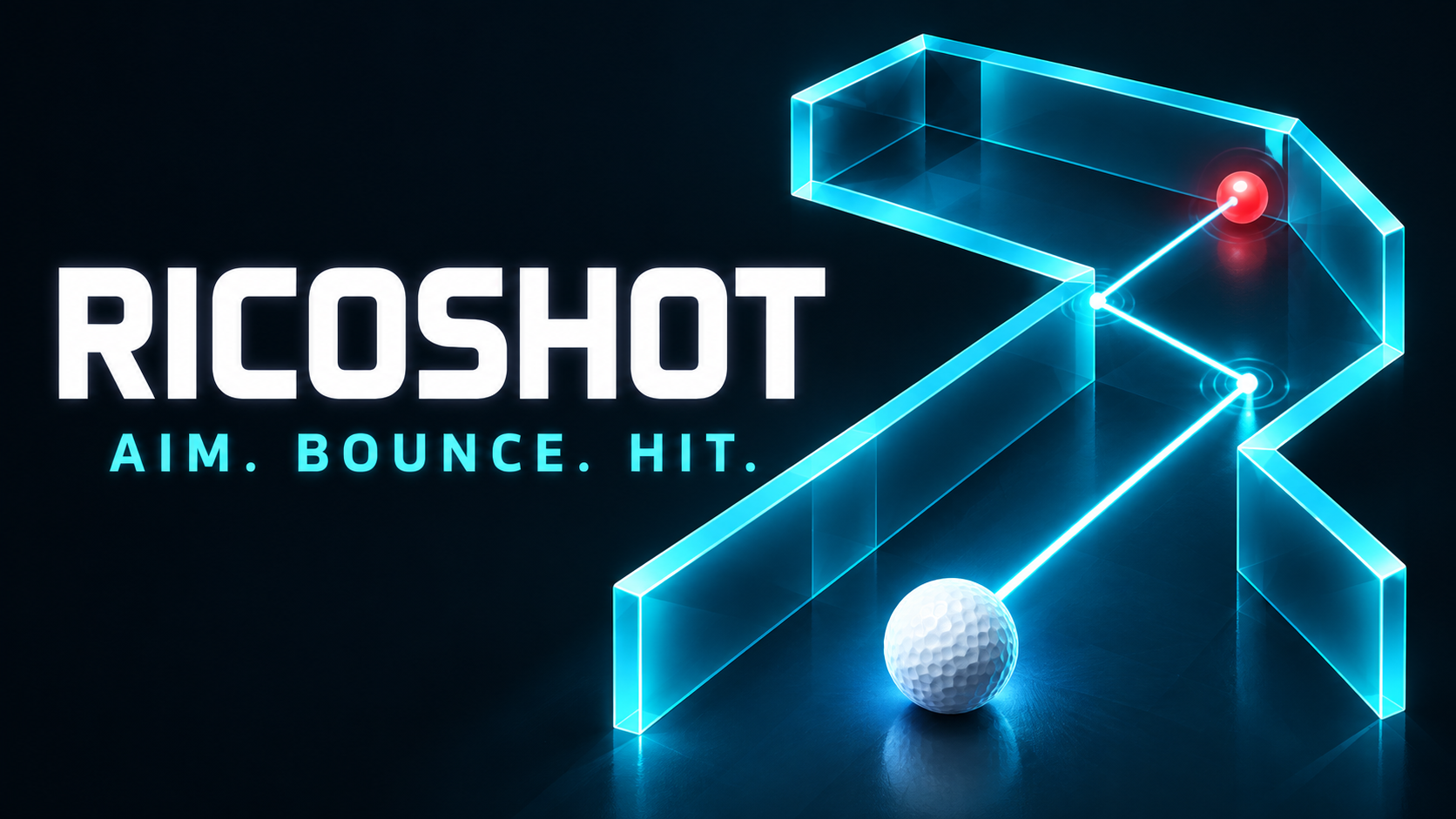
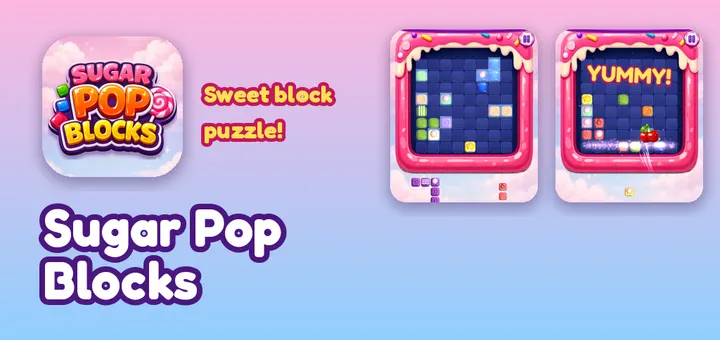
Physics puzzles add "the tactile satisfaction of a shot bouncing exactly as you planned," and block puzzles add "the relief of a full line vanishing all at once." Keke Studio's RICOSHOT is a sci-fi 3D bank-shot golf puzzle where you bounce balls off walls into the hole, and Sugar Pop Blocks is a block puzzle where you fill and clear blocks, each built around one of these two kinds of fun.