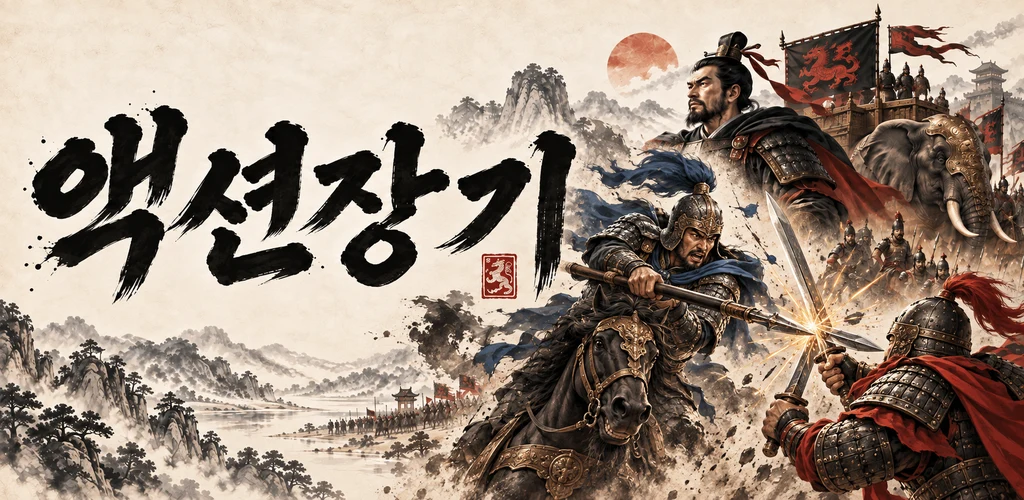
Janggi History and Rules: Korea's Traditional Chess Game
Where janggi came from, its link to xiangqi, how each piece moves, palace rules and bikjang, basic strategy, and digital janggi today.
Elderly men gathered around a park bench shouting "Janggun!" (check) and "Meonggun!" (the reply to check) has long been a familiar sight in Korea. Along with baduk (Go), janggi is one of the board games Koreans have enjoyed the longest. But many people don't know what "Cho (楚)" and "Han (漢)" on the janggi board mean, or when and how janggi took root on the Korean Peninsula.
In this post, we first look at janggi's origins, old records, and how it differs from Chinese xiangqi, then cover how the pieces move, the palace rules, bikjang and scoring, and basic strategy for beginners. Finally, we introduce how janggi carries on digitally today.
What Is Janggi?
Janggi (將棋) is an abstract strategy board game in which two players, each with 16 pieces, try to capture the opponent's king (general). One side is red Han (漢), and the other is blue (or green) Cho (楚). This is modeled on the Chu–Han Contention, in which Liu Bang of Han and Xiang Yu of Chu fought for control of China after the fall of the Qin dynasty. Traditionally, Han's pieces are engraved in neat regular script, and Cho's pieces in flowing cursive script.
The janggi board consists of 90 intersections where 9 vertical lines and 10 horizontal lines meet, and the pieces are placed on the points where lines cross, not inside the squares. In South Korea, it's called "Korean janggi" when distinguishing it from other countries' versions, and in English it's also known as "Korean chess."
Janggi's Origins: From Chaturanga to Xiangqi to Janggi
There are several theories about janggi's roots.
- Chaturanga theory: Like chess, xiangqi, and shogi, janggi branched off from the ancient Indian board game chaturanga. The branch that went west became chess, and the ones that went east became xiangqi and janggi.
- Song dynasty theory: It was transmitted to Goryeo around the time of China's Song dynasty and gradually changed into its present form.
- Four Commanderies theory: There's also a widespread theory that the Han Chinese brought it in during the period of the Four Commanderies of Han, but Korean Wikipedia explains that this is hard to accept, since the accepted view is that chaturanga dates to the 6th century and its transmission to China to around the 8th century.
What's clear is that janggi branched off from xiangqi (象棋), Chinese chess. English Wikipedia also describes janggi as a game derived from xiangqi. Xiangqi had already taken on its present form by the Southern Song period, and janggi developed its own unique rules on the Korean Peninsula based on it.
Janggi in Old Records: From "Sanghui" to "Janggi"
In Joseon dynasty literature, janggi first appears under the name "sanghui (象戱)."
| Source | Content |
|---|---|
| Samguk Sagi | There's a record that King Gaero of Baekje enjoyed "bakhyeok (博奕)," but it's likely a term referring to various board games collectively. |
| Seo Geo-jeong, Pirwon Japgi | A record that Kim Seok-jeong and Kim Ye-mong, officials under King Sejong, played sanghui |
| Annals of King Sejo | Contains stories involving janggi under the name sanghui |
| Sim Su-gyeong, Gyeonhan Jamnok | A record by a civil official from around King Jungjong's reign, where the word "janggi" finally appears |
| Jang Yu, Gyegokjip, "Sanghuiji" | Describes the theory in detail, from the lines on the board and the roles and movements of the pieces to winning and draws (bik) |
Gyeonhan Jamnok explains that janggi uses chariots, cannons, horses, elephants, guards, and soldiers, and that the pieces are carved from wood, engraved with characters, and painted. Eou Yadam introduces Seocheon-ryeong, a member of the royal family, as a master of janggi, showing that janggi was so widely enjoyed in the Joseon era that skilled players could make a name for themselves.
How It Differs from Xiangqi
Janggi and xiangqi have almost the same board size (9×10) and piece composition, but when you actually play them, they're quite different games.
- No river: The xiangqi board has a "river" in the middle dividing the two sides, but the janggi board doesn't. So elephants can advance freely into the opponent's territory.
- King's position: In xiangqi, the general starts at the center of the back row, but in janggi, the king starts at the very center of the palace.
- Elephant movement: The xiangqi elephant moves two points diagonally, but the janggi elephant goes farther, moving one point straight and then two points diagonally.
- Cannon rules: The janggi cannon must jump over exactly one other piece both when moving and when capturing, and cannons can't jump over or capture other cannons.
- Soldier movement: Janggi soldiers can move sideways from the very start.
- Bikjang and passing: The kings facing each other (bikjang) is forbidden in xiangqi, but in janggi it becomes a way to call for a draw. Janggi also allows "passing," skipping your own turn.
- Swapping horse and elephant: In janggi, you can swap the positions of the horse and elephant before the game starts.
Types of Pieces and Their Moves
Each side has 16 pieces in total: 1 king, 2 chariots, 2 cannons, 2 horses, 2 elephants, 2 guards, and 5 soldiers. The points below are the values used in point-based games under the Korea Janggi Association standard.
| Piece | Count | Movement | Points |
|---|---|---|---|
| King (楚·漢) | 1 | One point along the lines within the palace. Cannot leave the palace | None |
| Guard (士) | 2 | One point within the palace, like the king | 3 |
| Chariot (車) | 2 | Any distance horizontally or vertically in a straight line. Can also move diagonally within the palace | 13 |
| Cannon (包) | 2 | Moves and captures by jumping over one other piece. Cannot jump over or capture cannons | 7 |
| Horse (馬) | 2 | One point straight + one point diagonally. Cannot move if the first point is blocked | 5 |
| Elephant (象) | 2 | One point straight + two points diagonally. Cannot move if the path is blocked | 3 |
| Soldier (卒·兵) | 5 | One point forward or sideways. Cannot move backward. Can also move diagonally forward within the opponent's palace | 2 |
The chariot is the strongest piece, and the cannon is especially strong in the opening when there are many pieces to jump over, but it weakens in the endgame as pieces dwindle. Soldiers don't turn into other pieces even when they reach the far end.
The Palace and Setting Up the Board
The Palace
At the bottom center of each side is the "palace," made up of 9 points on 3 lines by 3 lines. Diagonal lines in an X shape are drawn inside the palace, and the king and guards move only within it. Chariots, cannons, and soldiers can also move along the diagonals inside the palace, making the palace the place where attack and defense clash most fiercely.
Setting Up
The king goes at the very center of the palace, the guards at the back on either side of the king, and the chariots at both ends of the back row. Soldiers are placed on the fourth row with one point between each, and cannons go on both sides of the third row. In the empty spots between the chariots and guards, one horse and one elephant are placed on each side; since their order can be swapped, there are four possible setups. Depending on the elephant positions, they're called the left-elephant/right-elephant (gwima), inner-elephant (wonangma), and outer-elephant (yanggwima) setups.
Flow of the Game and Deciding the Winner
Cho always moves first. By tradition, there's a custom called "noh-hong so-cheong (老紅少靑)," under which the elder player takes Han (red).
- Janggun and meonggun: A move that directly attacks the opponent's king is called "janggun," and a move that blocks or escapes it is called "meonggun."
- Checkmate (oetong): If you call janggun and the opponent has no way to answer with meonggun, the game ends in "oetong."
- Bikjang: The state in which the two kings face each other in a straight line with nothing in between. The side at a disadvantage may call bikjang aiming for a draw, though some games don't recognize it.
- Point system: In official tournaments, when time runs out, the winner is decided by the points of the remaining pieces. Han, who moves second, is given a 1.5-point bonus (deom), so the starting scores are 73.5 points for Han and 72 for Cho.
The Korean expression "playing without the chariot and cannon" also comes from janggi. It comes from "handicap janggi," in which the stronger player removes the most important pieces, the chariot and cannon, when there's a big gap in skill.
Basic Strategy for Beginners
- Activate your chariots early. The chariot is the strongest piece, but at the start it's blocked in the corner. The basic move is to shift the soldier in front of it sideways to open the chariot's path.
- Think about the cannon's "bridge." A cannon can only move if there's a piece to jump over. Removing the bridge in front of the opponent's cannon pins it, and placing a bridge in front of your own cannon creates an attack route.
- Check the paths of horses and elephants. Horses and elephants can't move if a piece is in their way. Simply blocking the first point of the opponent's horse can reduce a big threat.
- Don't move your guards carelessly. Guards are the last wall protecting the palace. If a guard leaves, the palace becomes easily exposed to diagonal attacks from chariots and cannons.
- Learn the openings. The basic openings are "myeonpo," which places a cannon in front of the palace (myeon), and "myeonsang," which places an elephant there. The five representative openings used today were established in the mid-to-late 1950s.
Janggi Today and Digital Janggi
In Korea, janggi is less popular with the general public than baduk, but organizations such as the Korea Janggi Association work to promote it and keep the tradition alive. In October 2009, the first international tournament, a world janggi competition, was held in Harbin, China.
Recently, more people play janggi on screens than in parks. You can find opponents anytime on online play sites and mobile apps, and computer engines that support janggi, such as the open-source engine Fairy-Stockfish, are publicly available. Overseas, janggi can be played on sites like pychess.org, and players outside Korea are emerging too.
KEKE STUDIO's Action Janggi brings janggi into 3D, with real battles fought by each unit type whenever pieces clash. You can play against AI or have two people take turns on one device; the first 10 games are free, and after that you can keep playing with a single one-time payment of 900 won (released on Google Play in Korea).