History of Mobile Games: From Snake to the App Store and Today
How mobile games went from Nokia's Snake and feature phones to the App Store, Angry Birds, free-to-play, Pokémon GO, and hyper-casual to lead gaming.
Today, playing games on your phone on the subway is an all-too-familiar sight, but mobile gaming started with a few dots moving across a black-and-white screen. In 30 years, those small games grew into a huge market that accounts for roughly half of global game revenue.
In this post, we look at the history of mobile games in five stages: Snake, which came built into feature phones; the Java game era, when carriers controlled distribution; the smartphone era opened by the App Store in 2008; the shift in business models brought by free-to-play and in-app purchases; and the path through Pokémon GO and hyper-casual games to today.
The First Mobile Phone Games and Nokia's Snake
According to English Wikipedia, the earliest mobile phone game was a Tetris variant included on the Hagenuk MT-2000 phone from Germany in 1994. But it was Nokia's Snake that introduced the idea of mobile phone games to the public.
Snake is a simple game in which you move a snake that grows longer the more food it eats, and the game ends when you hit a wall or your own body. It first appeared on the Nokia 6110 in the late 1990s (sources list either 1997 or 1998) and came preinstalled on Nokia phones for many years after. English Wikipedia states that Snake was installed on 350 million devices worldwide.
Snake matters because it was the first to clearly show the demand that "people play games on their phones, too." Nokia went on to include sequels such as Snake II and Snake Xenzia, and in 2012 the Museum of Modern Art (MoMA) in New York announced the Nokia version of Snake as one of 40 games it wanted to add to its collection.
The Feature Phone Era: i-mode, Java, and the Carriers
When Japan's NTT Docomo launched its i-mode service in 1999, the era of downloading games to phones began. Major Japanese game companies such as Konami, Taito, Namco, and Hudson announced games for i-mode, and by 2001, i-mode had 20 million users in Japan alone.
By the mid-2000s, most mobile phone games were built on Java (J2ME). Several other platforms were also used, including Qualcomm's BREW, Korea's WIPI, and Symbian. This era had the following characteristics.
- Carrier-centered distribution: In the United States, mobile carriers such as AT&T and Verizon served as the storefronts for games.
- Every device was different: Screen sizes, button layouts, and performance varied by model, so the same game had to be made in countless versions.
- One-time purchases: Paying a fee when downloading a game was the norm.
The market grew steadily, too. Informa Telecoms & Media estimated global mobile game revenue in 2005 at $2.6 billion.
2008: The App Store Changes the Game
The turning point was Apple. The iPhone came out in 2007, and on July 10, 2008, Apple's App Store opened with about 500 apps. The iPhone 3G, released the next day, came with the App Store built in. Google also opened the Android Market on October 22 of the same year, and it was renamed Google Play in March 2012.
The App Store brought three major changes.
| Change | Before (feature phones) | After (smartphones) |
|---|---|---|
| Distribution | Storefronts managed by carriers | App marketplaces run directly by platform owners |
| Developers | Mostly companies able to sign carrier deals | Individuals and small teams can launch right away |
| Controls | Number keys | Touchscreens, tilt sensors, and more |
English Wikipedia describes the App Store as "the first content marketplace run directly by a mobile platform holder." Thanks to it, even small independent developers could sell games directly to users around the world. Apple took 30% of sales as a commission, and in December 2020 it announced a program lowering the commission to 15% for developers earning less than $1 million a year.
Angry Birds: The First Mass Hit Made for Touchscreens
The game that defines the early smartphone era is Angry Birds by Finland's Rovio. Rovio had previously been a developer that made 51 games on commission for other companies, and when the company fell on hard times, it decided to make its own game.
Angry Birds was released on iOS on December 11, 2009. It's a physics puzzle game in which you launch birds from a slingshot to topple structures where pigs are hiding, and the pull-and-release finger control was a perfect fit for touchscreens. It was downloaded more than 50 million times by 2010 and later became a major franchise spanning animation, movies, and theme parks.
Around the same time, games like Cut the Rope and Fruit Ninja also became popular, establishing the grammar of mobile games enjoyed "briefly, with a finger, anytime."
The Era of Free-to-Play and In-App Purchases
In October 2009, Apple introduced in-app purchases, which let users buy additional content within an app. This fundamentally changed the business model of mobile games.
Candy Crush and the "Stamina" Model
In 2012, King's Candy Crush Saga and Japanese developer GungHo's Puzzle & Dragons limited the number of plays with "lives" or "stamina" that recharged over time, letting those who didn't want to wait keep playing right away by paying. This approach attracted huge numbers of players and big revenue at the same time, making the free download + in-app purchase model the industry standard.
According to English Wikipedia, revenue from free games usually comes from paying users who make up less than 10% of all players, and among them, about 2% of high spenders account for a large share. This structure let many people play for free, but it also drew criticism for pushing excessive spending.
Clash of Clans and Live Service
Finnish developer Supercell's Clash of Clans was released on iOS on August 2, 2012, and on Android on October 7, 2013. It's a strategy game in which you build up your village and attack other people's villages, and cooperative elements such as "clans" of up to 50 players and clan wars are at its core. With steady updates, it became a model for long-running mobile live-service games.
Pokémon GO: Taking Smartphones Outside
Pokémon GO, first released on July 6, 2016, in Australia, New Zealand, and the United States, is a game that uses GPS and augmented reality to let you catch Pokémon while walking around real streets. It was made by Niantic together with Nintendo and The Pokémon Company.
Pokémon GO was downloaded more than 500 million times in 2016 alone and passed 1 billion cumulative downloads by early 2019. Its revenue through 2020 exceeded $6 billion. At launch, it wasn't officially available in Korea due to restrictions on exporting map data, but when word spread of a glitch that made the game work only around Sokcho in Gangwon Province, many people flocked to Sokcho.
The game showed how big a response could come from gameplay only smartphones can offer, namely games that use location data and the camera.
Hyper-Casual: Ultra-Short Games Funded by Ads
Flappy Bird, made by Vietnamese developer Nguyen Ha Dong in May 2013, suddenly became hugely popular in early 2014. All you did was tap the screen to fly a bird between pipes, but the developer said that at its peak it earned $50,000 a day from ads and other sources. He took the game down himself on February 10, 2014.
Around 2017, games like these were grouped under the name "hyper-casual" and became a trend of their own. Companies such as Voodoo, Ketchapp, and Kwalee are representative. Hyper-casual games have the following traits.
- One-handed controls you can start without any explanation
- Simple 2D graphics and an endlessly repeating structure
- A business model that earns from ads (rewarded video, banners, and interstitials) rather than purchases
Investment poured in, too. Ubisoft acquired Ketchapp in 2016, and in 2017 Goldman Sachs invested $200 million in Voodoo.
Mobile Games Today
Around 2016, mobile game revenue surpassed other segments of gaming, and it is now the largest segment of the game industry. Estimates of mobile's share of global game revenue in 2025 range from 49% to 56%, depending on the source.
Recent trends can be summed up as follows.
- PC- and console-quality blockbusters: Big games that compete with other platforms have increased, such as PUBG Mobile, released on March 19, 2018, and Genshin Impact, launched simultaneously in 2020 on Android, iOS, PC, and PlayStation 4.
- Cross-platform: Continuing play with the same account across phone, PC, and console has become common.
- Subscriptions and new distribution: Apple launched its game subscription service Apple Arcade in September 2019, and regulation and lawsuits over App Store commissions continue.
- Genre diversification: Nearly every genre, from puzzle and strategy to defense and RPG, is being remade to fit mobile.
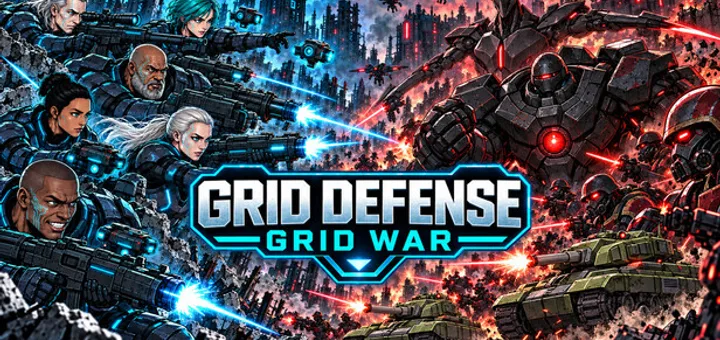
Starting from Snake on a black-and-white screen, mobile games have become the form of gaming enjoyed by the most people. Making a game you can finish in a short session while still packing in deep strategy remains the challenge mobile game developers wrestle with most. KEKE STUDIO's GRID DEFENSE: GRID WAR grew out of the same challenge: it's a sci-fi tactical tower defense game set in a city in 2087, where you command towers and six Wardens.