What Are Sports Games? Types and History From Pong to Wii Sports
Sports games explained: subgenres like simulation, arcade, and management, and a history from Tennis for Two and Pong to FIFA, PES, and Wii Sports.
Sports games are one of the oldest genres in video games. In 1958, a tennis ball bounced back and forth on the screen of an analog computer at a research laboratory, and Pong, which swept the arcades in 1972, was a simplified take on table tennis. Since then, nearly every sport, from soccer, baseball, basketball, and golf to snowboarding, has been turned into a game.
Sports games have the big advantage that there's little need to learn new rules. Anyone who knows soccer immediately understands the goal of a soccer game. That's why sports games have also served as a bridge connecting games to people who rarely play them.
In this post, we go through the definition and appeal of sports games, their subgenres, landmark titles in their history, design characteristics, who they suit, and today's market.
Definition and Core Appeal
English Wikipedia defines a sports video game as "a video game that simulates the practice of sports." Most sports, from team sports and track and field to extreme sports and combat sports, have been made into games. Broadly speaking they're a branch of simulation, but thanks to their long history and large market, they're usually treated as a genre of their own.
The fun of sports games comes from the following.
- Competition on familiar rules: There's the tension of beating an opponent within rules everyone knows. It's as competitive as real sports.
- Favorite players and teams: Many games feature real league and player names and ratings, giving you the vicarious thrill of leading the team you support yourself.
- Plays that are hard to pull off physically: Long-range shots and dunks that are impossible in real life take just a few fingers.
- Playing together: It's a great genre for teaming up with or facing off against friends on the same screen.
Subgenres
Sports games can be divided by sport, but the differences show up more clearly when you divide them by what they emphasize.
| Type | Characteristics | Examples |
|---|---|---|
| Simulation | Real league and player licenses, realistic physics and broadcast presentation | EA Sports FC (formerly FIFA), Madden NFL, NBA 2K |
| Arcade | Exaggerated, simplified rules for fast, explosive play | NBA Jam, the Mario sports series |
| Management | Player signings, tactics, and club operations instead of controlling matches | Football Manager |
| Extreme sports | Trick-focused sports like snowboarding and skateboarding | Tony Hawk's Pro Skater, SSX |
| Motion-controlled | Controlled by moving your body | Wii Sports, Wii Fit |
| Fictional sports | Sport-like games built on rules that don't exist in reality | Rocket League (soccer played with cars) |
By sport, soccer, American football, baseball, basketball, golf, tennis, and combat sports are the most prominent. Wikipedia names soccer games as the most popular subgenre in Europe. Motor racing is so large that it's usually treated as a separate genre, "racing games."
Landmark Games in History
| Year | Game | Developer | Notes |
|---|---|---|---|
| 1958 | Tennis for Two | William Higinbotham (Brookhaven National Laboratory) | An early video game built with an analog computer and an oscilloscope |
| 1972 | Pong | Atari (Allan Alcorn) | The first commercially successful video game |
| 1983 | Track & Field (Hyper Olympic) | Konami | An arcade game in which up to four players compete in various track and field events |
| 1983 | One on One: Dr. J vs. Larry Bird | Electronic Arts | The first licensed sports game to use the names and likenesses of real star athletes |
| 1985 | Tehkan World Cup | Tehkan (later Tecmo) | Shot direction and power controlled with a trackball; the template for top-down soccer games |
| 1988 | John Madden Football | Electronic Arts | The start of the Madden NFL series |
| 1993 | NBA Jam | Midway | 2-on-2 basketball with exaggerated dunks and physical play |
| 1993 | FIFA International Soccer | EA Canada / EA Sports | The first FIFA game, with an angled isometric view |
| 1997 | International Superstar Soccer Pro | Konami Tokyo | Tactics-focused 3D soccer that later led to Winning Eleven/PES |
| 1999 | Tony Hawk's Pro Skater | Neversoft / Activision | Sparked the extreme sports game boom |
| 2006 | Wii Sports | Nintendo | Five sports played by swinging the Wii Remote; 82 million copies sold |
| 2015 | Rocket League | Psyonix | A fictional sport of kicking a ball with rocket-powered cars |
In the early 1980s, as the arcade market was cooling, sports games helped draw customers back. Sega's Champion Baseball, released in 1983, was a big success in Japanese arcades, and Konami's Track & Field, released the same year, became popular in arcades worldwide with its format of multiple players hammering buttons to compete for records. EA's One on One sold 400,000 copies by the end of 1988, becoming the best-selling computer sports game of its time, and from then on, "featuring real star athletes" became a key selling point for sports games. In the 1990s, EA established the practice of releasing a new season edition every year, and in 1997 there were reports that sports games accounted for about 50% of console software sales.
Soccer games in the 2000s were defined by the rivalry between EA's FIFA and Konami's Winning Eleven (known abroad as Pro Evolution Soccer). Wikipedia describes this competition as the "biggest rivalry" in sports game history. FIFA's strength was considered to be its official licenses, while PES's was its tactical gameplay.
Design Characteristics
- Switching between modes: In American football games, even a single pass involves a chain of control phases, such as choosing a play, catching the ball, and running. Soccer games also change control schemes for penalty kicks. Because they follow real matches, these transitions feel relatively natural.
- How long you hold a button: It's common to turn button presses into continuous power, such as a short pass for a tap and a long pass for a long press. Golf games long used a scheme where one press starts the backswing and another press swings.
- Simplified physics: Most games reduce elements like inertia to make controls easier. They also let you set match lengths shorter than in real life.
- Broadcast presentation: Recorded commentary and TV-style camera angles heighten immersion. A 1983 baseball game for the Intellivision is cited as the first to use multiple camera angles imitating a TV broadcast.
- Licenses and annual updates: Real league and player licenses have a big impact on sales. It's standard to release a new version every year reflecting player transfers and rating changes.
- Stat modeling: Each player gets values like speed, strength, and accuracy to represent real-life differences.
Who Should Play Them
- People who love real sports and have a team or player they support
- People who want to enjoy competing with friends or family on the same screen
- People who want games with short matches and clear rules
- People who'd rather think about tactics and squad building like a manager than play the matches themselves (management games)
Sports Games Today
In the North American market today, EA Sports and 2K Sports hold the official licenses for the major leagues. EA publishes the Madden NFL, NHL, and EA Sports FC series, while 2K publishes the NBA 2K and WWE 2K series, among others. Wikipedia explains that these exclusive licenses have made it hard for new competitors to enter. Meanwhile, Nintendo is taking a different path with lighthearted sports games starring Mario.
Another trend is games that get you moving. Wii Sports let people play tennis and bowling just by swinging, drawing in even those who didn't play games. There are also cases like Rocket League, where a game that turned a sport that doesn't exist into something sport-like went on to become an esports competition.
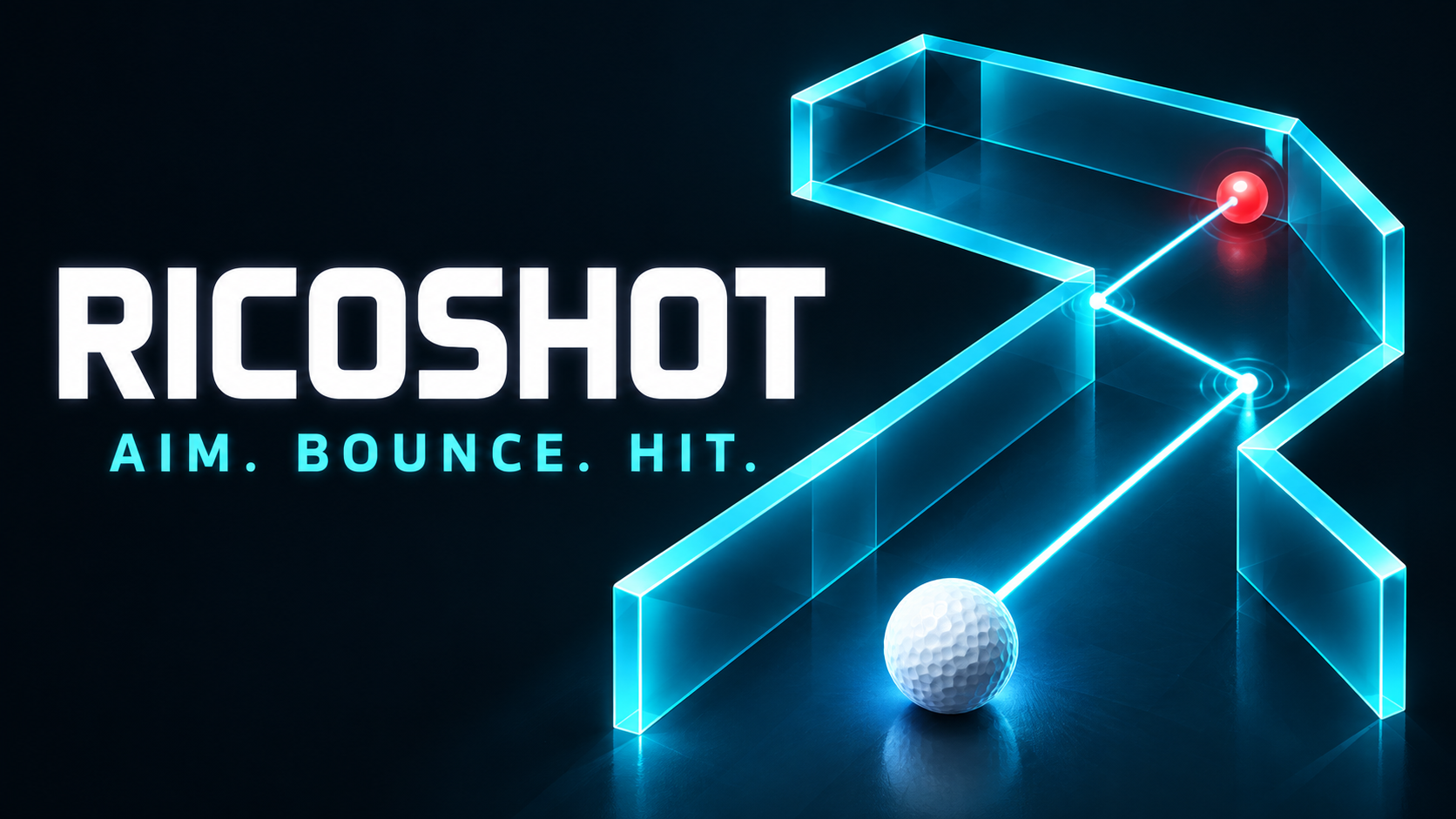
Many games also borrow only part of a sport's rules rather than following them exactly. Golf's rule of "hit the ball into the hole" pairs well with puzzles. Keke Studio's RICOSHOT: Golf Puzzle is a game where you check the predicted trajectory and bounce the ball off walls to hit the target on sci-fi themed 3D courses, letting you enjoy the feel of a golf shot from the puzzle side.