Tetris: The Soviet-Lab Block Puzzle That Conquered the World
How Alexey Pajitnov created Tetris, how it plays, why it's a classic, its sequels and influence, and the best ways to play it today.
Tetris is a puzzle game in which you rotate and move falling blocks to fill horizontal lines. Its rules are simple enough to explain in a single sentence, yet over the decades it has been ported to nearly every console, computer, and phone, and new versions are still coming out today.
In this post, we look at how Tetris was made at a research institute in the Soviet Union, how its basic rules and scoring work, why it has long been considered a classic, and which sequels, tournaments, and even a film it led to. At the end, we also cover ways to play Tetris today.
At a Glance
| Item | Details |
|---|---|
| Release | First created in the Soviet Union around 1984–1985 (dates vary by source) |
| Developer | Alexey Pajitnov (Dorodnitsyn Computing Centre) |
| Platforms | Started on the Electronika 60, then ported to countless devices including the IBM PC, Famicom/NES, and Game Boy |
| Genre | Falling-block puzzle |
Origins
Tetris was created by Alexey Pajitnov, a software engineer at the Dorodnitsyn Computing Centre of the Soviet Academy of Sciences. He was a researcher working on speech recognition and artificial intelligence, and Tetris was something he made in his spare time, not as part of his job.
The exact completion date differs slightly between sources. Some recollections say it was made in 1984, while one interview says it was finished in 1985. The first version ran on the Soviet-made Electronika 60 computer and was written in Pascal on the RT-11 operating system.
The name combines "tetra," the Greek for four, with tennis, Pajitnov's favorite sport. It directly reflects the fact that each block is made of four squares.
Pajitnov then spent about two months building an IBM PC version with his colleague Dmitry Pavlovsky and Vadim Gerasimov, who was 16 at the time. Gerasimov added color, and Pavlovsky added a scoreboard. As copies of this PC version spread beyond the institute, Tetris began to become known outside the Soviet Union.
The rights situation was complicated. In the Soviet era, software exports had to go through the state agency Elorg, and several companies negotiated over the rights. Henk Rogers, who ran a game company, negotiating directly with Elorg and securing the handheld and home console rights for Nintendo is one of the most famous episodes in Tetris history.
How It Plays
The blocks in Tetris are "tetrominoes," made by joining four squares, and there are seven shapes in all. They are commonly referred to by the letters I, O, T, S, Z, J, and L.
The basic flow is as follows:
- Blocks fall one at a time from the top of the playfield.
- The player moves blocks left and right or rotates them, then drops them into place.
- When a horizontal line is completely filled, it disappears and the blocks above move down.
- If blocks stack up to the very top, the game is over.
The more lines you clear at once, the higher the score. Clearing four lines simultaneously with the straight I block is called a "Tetris," just like the game's name, and it usually earns the most points. As time passes and the level rises, blocks fall faster, so the same rules demand ever quicker decisions.
Features like a preview of the next block and "Hold," which lets you store a block for later, were added or standardized over later versions. Tetris DS (2006) is regarded as the version that introduced the scoring system widely used today.
Why It's a Classic
First, the rules are simple. Even without knowing the language or culture, anyone can tell what to do after watching the screen for a few seconds. Thanks to this simplicity, Tetris ran even on low-powered devices and became one of the first games ported to every new device. Guinness World Records recognizes Tetris as the game ported to the most platforms (at least 70).
Second, it endlessly generates new situations. There are only seven blocks, but the order they come in and the shape of the stack differ every time, so no two games are the same. Players have to think about where to place the current piece and what gaps will form later at the same time, and as the speed increases, this judgment turns into muscle memory.
Third, it pairs perfectly with handheld consoles. The Game Boy version of Tetris was released in Japan on June 14, 1989, and in North America it was sold bundled with the Game Boy starting July 31 of the same year. Tetris, which can be played in short bursts, suited a portable device well, and the Game Boy version is the best-selling of all Tetris versions, with sales recorded at 35 million copies.
Fourth, it has depth. The Classic Tetris World Championship, centered on the NES version, has been held every year since its first event in 2010. On December 21, 2023, a player named Willis Gibson made headlines by playing the NES version until the game crashed. The fact that new records and techniques are still emerging decades after release shows just how deep Tetris is.
Sequels and Influence
Tetris is less a single game than a series with countless versions. Guinness World Records counts around 220 official versions alone. In 1996, Elorg and Henk Rogers's Blue Planet Software jointly founded The Tetris Company and began managing the brand and its licensing.
Notable versions include:
- Famicom/NES versions: The Famicom version came out in December 1988 and the NES version in 1989. The NES version is still the standard for competitive play.
- Puyo Puyo Tetris: Released in Japan on February 6, 2014, it lets players compete with Sega's Puyo Puyo and Tetris in the same game.
- Tetris Effect: Released on PlayStation 4 on November 9, 2018. It is known for music and visual effects that change in sync with your play, and Tetris Effect: Connected, which added online multiplayer, came out in 2020.
- Tetris 99: Released on February 13, 2019, for Nintendo Switch Online members. With 99 players competing at once, it brought the battle royale genre to puzzles.
Its influence extended beyond games. The story of the negotiations over the Tetris rights was made into the film Tetris, released on Apple TV+ on March 31, 2023, with Taron Egerton playing Henk Rogers. In April 2014, an event in Philadelphia used the exterior lights of the Cira Centre building to play Tetris, earning a Guinness record for the "largest architectural video game display."
Matching blocks to clear lines or clusters became the starting point for countless puzzle games that followed. Whether pieces fall or are dragged into place, Tetris's idea of "filling gaps to clear them" is easy to find in today's mobile block puzzles.
How to Play Today
Tetris can still be played in many ways. The easiest is to open the web version offered on The Tetris Company's official site. If you own a Nintendo Switch, you can compete against other players in Tetris 99 for Nintendo Switch Online members, and if you want to enjoy the presentation and music as well, Tetris Effect: Connected is a great choice. If you want the classic feel, it's also fun to watch tournament videos played under NES rules and compare playstyles.
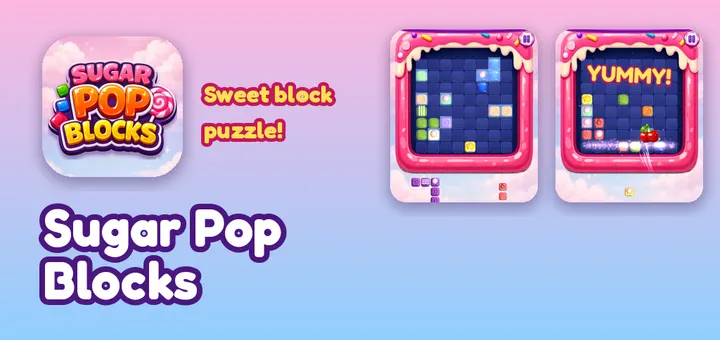
If you enjoy filling gaps to clear blocks, Keke Studio's block puzzle game Sugarpop, where you drag and drop blocks to clear lines, offers a similar kind of fun.